
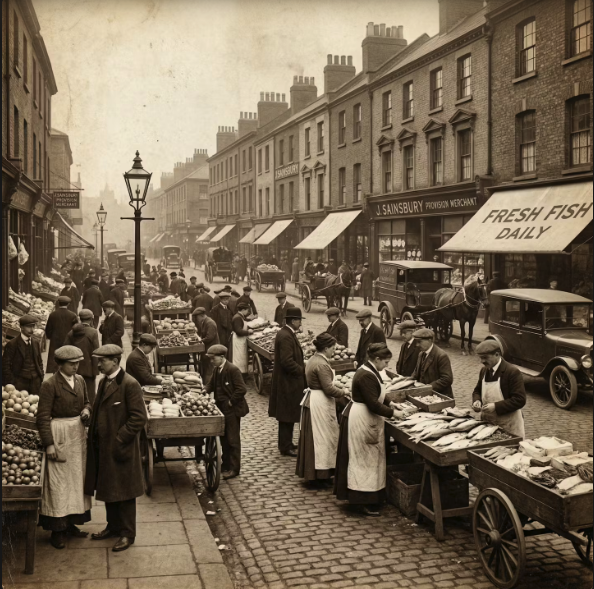
A long time ago – before online shopping, booking systems, or even permanent shops – markets were where life happened!
They were important places of trade, but also places for people to gather, share news, meet neighbours, and to mark the rhythm of a community. Markets weren’t just economic centres; they were social ones. And in many ways today, they still are!
Markets Before Modern Cities
Some of the earliest “markets” appeared wherever people naturally crossed paths: river landings, crossroads, gates, temples and ports. In Athens, the Agora was already a central public space by the 5th century BCE, not just for buying and selling, but for civic life and debate.
Across medieval Europe, markets scaled up into fairs that stitched regions together. The Champagne fairs flourished in the 12th and 13th centuries, operating as a coordinated circuit where merchants, money, cloth, leather, and spices moved across borders in such an organised way for that era.
These early markets worked because they were practical and human: People met face to face, and trust was earned in public
When Kings Got Involved (Because Markets Mattered That Much)
Markets weren’t “small” in the eyes of power. In fact rulers moved quickly to control them, protect them, tax them, and legitimise them.
In Paris, what became Les Halles began as a market by a cemetery in the 11th century. By 1137, authority over the market was being shared with King Louis VI – which served as a clear reminder that the market wasn’t just a place to shop, but a source of influence and revenue. In 1183, Philip Augustus built covered halls to protect goods (especially textiles) and tightened control of the area.
In England, King John granted a charter connected to what became Stourbridge Fair; the first fair is recorded in 1211, and it grew into one of the biggest medieval fairs in the country.
And in Istanbul, construction of what became the Grand Bazaar began around 1455/56 under Mehmed II, was designed to stimulate commerce after the Ottoman conquest.
More Than Just Buying and Selling
As markets evolved, their role expanded. They became places where:
- News was shared
- Skills were passed down
- Cultures mixed
- Traditions were formed
One of the simplest truths about markets, which still holds true today, is that they reveal a place. You can read a town through what it grows, cooks, makes, and values – often more honestly than you can from its high street.
Markets Evolve
Industrialisation, supermarkets, and global supply chains changed how people accessed goods, but thankfully markets didn’t disappear! Instead, they adapted, and re-emerged as anchors – because they’re not just supply chains. They’re social infrastructure!
Some became wholesale engines; others became weekly rituals.
And while today’s markets may look a little different, at the heart they’re still the same.
You’ll find food trucks next to farmers, artisans beside growers, live music, kids playing, dogs on leads, and conversations happening everywhere.
Modern markets are:
- Highly curated
- Logistically complex
- Built on community trust
- Powered by organisers doing a huge amount of work behind the scenes
The technology running them may be new, but the purpose isn’t.
Why History Still Matters
Understanding the history of markets reminds us why they’re worth protecting and investing in.
Markets:
-
Support local economies
-
Create pathways for small businesses
-
Strengthen community ties
-
Offer human connection in a digital world
For organisers, this context matters. You’re not just running events – you’re continuing a tradition that has existed for centuries!
Looking Ahead
Markets have always evolved to meet the needs of their time.
Today, that means balancing tradition with modern systems (like LocalStalls 😉), sustainability, compliance, and rising expectations. But at their core, markets remain what they’ve always been – places where people come together. Markets create a stage for local life – giving growers, makers, artists, and small businesses a place to share their work, and giving communities a space to showcase their region through its produce, crafts, and flavours.
And that’s definitely something worth supporting, and celebrating.
References
Medieval Trade, Fairs, and Commercial Networks
Braudel, Fernand. The Wheels of Commerce. Vol. II of Civilization and Capitalism, 15th–18th Century. Berkeley: University of California Press, 1992.
Britnell, Richard. The Commercialisation of English Society 1000–1500. Cambridge: Cambridge University Press, 1996.
Pirenne, Henri. Economic and Social History of Medieval Europe. London: Routledge, 1936.
Wikipedia contributors. “Champagne Fairs.” Wikipedia.
https://en.wikipedia.org/wiki/Champagne_fairs
Illuminating Facts. “Medieval Trade Fairs.”
https://illuminatingfacts.com/medieval-trade-fairs/
Paris: Les Halles and Royal Market Control
Le Goff, Jacques. Medieval Civilization 400–1500. Oxford: Blackwell, 1988.
Wikipedia contributors. “Les Halles.” Wikipedia.
https://en.wikipedia.org/wiki/Les_Halles
City of Paris. “Les Halles – Histoire.”
https://www.paris.fr/pages/les-halles-1800
England: Stourbridge Fair and Royal Charters
Power, Eileen. Medieval English Trade: The Beginnings of Commercial Organization. London: Methuen, 1921.
Wikipedia contributors. “Stourbridge Fair.” Wikipedia.
https://en.wikipedia.org/wiki/Stourbridge_Fair
Cambridge City Council. “History of Stourbridge Fair.”
https://www.cambridge.gov.uk/stourbridge-fair-history
Ottoman Istanbul: The Grand Bazaar
Faroqhi, Suraiya. Subjects of the Sultan: Culture and Daily Life in the Ottoman Empire. London: I.B. Tauris, 2005.
Wikipedia contributors. “Grand Bazaar, Istanbul.” Wikipedia.
https://en.wikipedia.org/wiki/Grand_Bazaar,_Istanbul
Kapalıçarşı Yönetimi. “Kapalıçarşı Tarihçesi.”
https://kapalicarsi.com.tr/tarihce
London: Borough Market and Urban Continuity
Wikipedia contributors. “Borough Market.” Wikipedia.
https://en.wikipedia.org/wiki/Borough_Market
Borough Market. “History of Borough Market.”
https://boroughmarket.org.uk/about/history/
Museum of London. “Markets and Trade in Medieval London.”
https://www.museumoflondon.org.uk/discover/medieval-london-trade
General Context: Markets, Power, and Governance
Wikipedia contributors. “Medieval Market.” Wikipedia.
https://en.wikipedia.org/wiki/Medieval_market